




Beauty is hidden in the most unappreciated places and it simply takes an open and appreciative heart to find it.
The First Step Through the Gate — A World Behind the Facade
You’ve walked right past them—dozens of times, probably. Those tall wooden doors, chipped at the bottom, leaning slightly like they’ve been holding back centuries. A few stickers from old utility companies. Maybe a curtain of ivy. And unless someone is stepping out or you happen to catch a glimpse through a brief crack, you’d never guess what’s on the other side.
But in Tbilisi, the story almost never starts on the street.
Push one of those doors open—just gently, respectfully—and you step into a different rhythm of the city. A courtyard. Not polished, not staged. Lived-in. Layered. Whispering.
You might see laundry stretching like bunting across the sky. A carved wooden balcony curling around the walls like lace. Children chasing pigeons, a grandmother shelling beans, a radio playing a Soviet-era pop song through a window somewhere. The light hits differently here—softer, quieter, as if it knows these places aren’t meant to be rushed.
It’s in these courtyards where Tbilisi really reveals itself.
Not through monuments or museums, but in the day-to-day poetry of lives overlapping. Generations passing down apartments, secrets, tea rituals, griefs, and gardens. If you’re paying attention, you start to feel it—that this isn’t just a place people live. It’s a memory that keeps evolving.
And the thing is, no two courtyards are alike. Each one holds its own mix of elegance and erosion, of past and present, woven into the architecture, the smells, the silence.
The first time I found one, I thought I’d discovered something rare. But soon I realized—the rare thing is realizing they’re all around you.
All you have to do is stop, listen, and step through.
Layers in Brick and Vine — Persian Tiles, Soviet Shadows, and New Voices
Once you’re inside a courtyard in Tbilisi, it doesn’t take long to feel that you’re standing in the middle of time itself. Not just old—layered. A patchwork of empires, ideologies, and generations, all held together by vine roots and rusty hinges.
Some of these spaces still carry the grace of Persian influence—you’ll see it in the colored tiles tucked beneath windows, the once-grand arches with floral details, the way the garden seems like the soul of the space rather than decoration. Georgia sat at the crossroads of empires for centuries, and the courtyards remember.
Then came the Soviet era, and with it, another chapter written in concrete and community. The courtyards changed—became denser, louder, more communal. You can almost picture it: five families sharing one kitchen, stories shouted from one floor to another, friendships and frustrations entwined with laundry lines. In a time when people had very little privacy, the courtyard became both sanctuary and stage. Resilience was woven into the bricks.
Today, things are shifting again. Slowly. Carefully. You’ll see the signs: a small artist’s studio in a former basement, a filmmaker projecting silent movies on the back wall, a café that doesn’t advertise but always seems to have just enough regulars. These courtyards—once utilitarian—are becoming sacred again. Not for tourists, not for show. But for the people who live here. The ones reimagining their roots without forgetting them.
That’s what makes these places so powerful: they don’t erase the past to make room for the present. They hold both. The chipped walls, the cigarette smoke, the child’s swing, the smell of dinner… they all speak at once.
And if you listen closely, you’ll hear them telling a story only this city could write.
Learning to Listen — How to Walk Slowly and See the Invisible
There’s a certain way you have to walk through Tbilisi—a slower way, a softer way. Because if you’re moving too fast, you’ll miss everything that matters. The city doesn’t shout its beauty at you. It murmurs. It waits. It hides things on purpose, maybe just to see who’s really paying attention.
That’s especially true with the courtyards.
You won’t find signs pointing to them. You won’t see them in travel brochures. Most locals won’t even think to mention them unless you ask. But if you learn to walk differently—to follow the smell of bread baking somewhere behind a fence, or the sound of clinking teacups echoing through a wooden hallway—you’ll start to notice the rhythm beneath the noise.
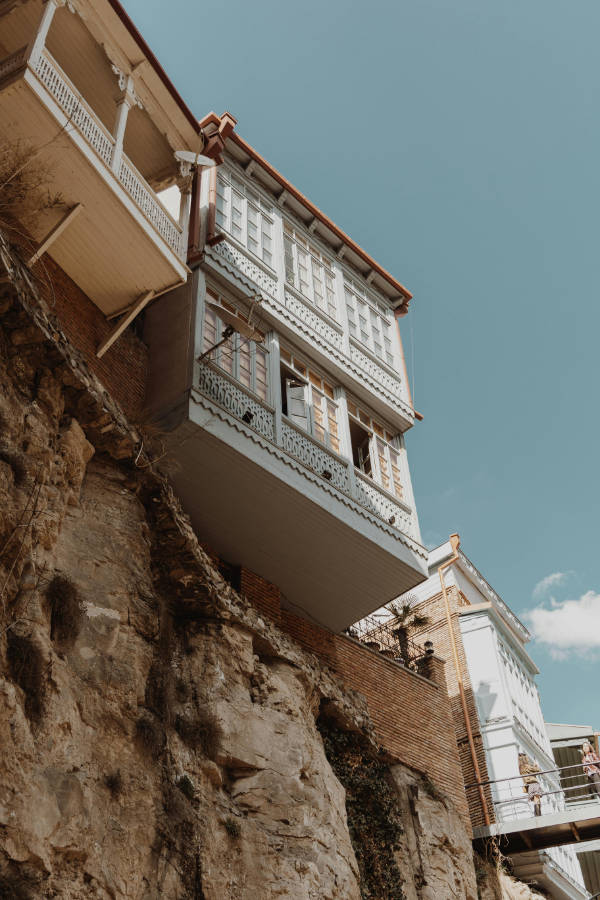
It’s in the way the balconies lean just a little too far forward, like they’re trying to tell you something.
It’s in the cracks of old staircases, the creak of doors that have been opened a thousand times.
It’s in the stories painted on walls, scratched into railings, whispered in the pause between someone playing the piano and someone else laughing downstairs.
If you enter a courtyard in Tbilisi, go gently. Don’t photograph everything right away. Don’t ask too many questions. Just… be there. Sit for a moment. Let the story find you.
Because that’s the thing about these places—they aren’t meant to impress you. They’re meant to invite you in. To remind you that cities aren’t made of steel and stone. They’re made of people. Of memories. Of moments too ordinary to write down, and too sacred to forget.
And when you leave, you might realize something strange:
It wasn’t the church domes or cable cars or statues that stayed with you.
It was a courtyard you almost walked past… and the way it made you feel like you belonged, even for a second.